
Restoring What Was Lost: technical breakdown, key moments and clinical context
Published on 16 April 2026 ('Restoring What Was Lost', 1:00 Short), this clip summarizes how ALS and spinal cord injury strip away physical independence and how participants in Neuralink's clinical trials use computer control, robotic arms, and speech synthesis to reclaim daily autonomy. Note: Neuralink disabled third-party iframe embedding on this Short (YouTube oEmbed HTTP 401), so our page provides a direct Watch on YouTube link alongside this full analysis.
- Primary record: Official
@neuralinkshort (9uqKeAJoD90) published on 16 Apr 2026 (duration1:00). - What it shows: How the same core N1 implant hardware supports multiple assistive modalities depending on cortical placement.
- Technical pathway: Cortical recording → Telepathy cursor / CONVOY arm / VOICE speech → daily independence.
- Evidence boundary: External embedding disabled by video owner (oEmbed 401); verified via watch page and caption track.
Watch the official video record
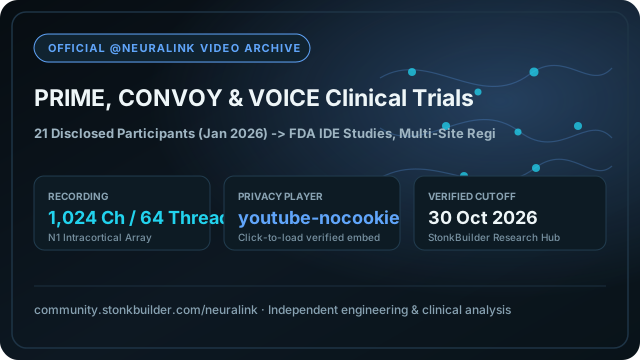
Official upload from @neuralink (16 Apr 2026, 1:00).
Read verbatim official @neuralink YouTube description & caption provenance
Caption & verification basis: English auto-generated captions (Official video playback, English caption track, official description, and primary Neuralink disclosures).
Life with ALS or a spinal cord injury often means navigating a gradual or sudden loss of independence.

Neuralink aims to restore autonomy to those with unmet medical needs—starting with device control and communication, and expanding toward vision and other applications.

Note: Neuralink devices are investigational and are not commercially available or FDA approved. This video features voluntary participants in clinical trials who chose to share their personal experiences. Their statements reflect individual perspectives and experiences, which may not be representative of all participants or future outcomes.
Technical pathway and evidence classification
Cortical recording → Telepathy cursor / CONVOY arm / VOICE speech → daily independence
External embedding disabled by video owner (oEmbed 401); verified via watch page and caption track.
Timestamped breakdown and key moments
| Timestamp | Segment / event | What happens in the segment |
|---|---|---|
00:00 | Impact of ALS and spinal cord injury | Frames the clinical need across paralysis and speech loss. |
00:30 | Cursor, robotic arm, and speech milestones | Montage of PRIME, CONVOY, and VOICE participant demonstrations. |
What this video demonstrates—and what it does not establish
What this video demonstrates
- How the same core N1 implant hardware supports multiple assistive modalities depending on cortical placement.
Scope limits & what it does not establish
- Overview montage; external embedding is disabled by the channel owner on YouTube.
How this fits into Neuralink's broader clinical and hardware roadmap
This video sits inside the Clinical trials, keynotes & vision research research track on StonkBuilder's independent Neuralink hub. All Neuralink hardware (the N1 implant and R1 surgical robot) and clinical programs (PRIME NCT06429735, CONVOY, and VOICE NCT07224256) remain investigational and have not received FDA commercial marketing authorization. Read our full companion guide at Clinical trials, keynotes & vision research for cohort context.
Sources checked 30 Oct 2026
Sources and official records
- [1] Neuralink YouTube (2026-04-16): Restoring What Was Lost ↗ · Verified 30 Oct 2026
- [2] Neuralink: Official YouTube Channel (@neuralink, UCLt4d8cACHzrVvAz9gtaARA) ↗ · Verified 30 Oct 2026
- [3] Neuralink: Official website and investigational device notice ↗ · Verified 30 Oct 2026
- [4] Neuralink: Clinical Trials and Patient Registry ↗ · Verified 30 Oct 2026
- [5] ClinicalTrials.gov: The PRIME Study (NCT06429735) ↗ · Verified 30 Oct 2026
- [6] Neuralink: Two Years of Telepathy (28 Jan 2026) ↗ · Verified 30 Oct 2026