
Speech restoration with Neuralink: inside the VOICE trial and real-time brain-to-voice decoding
Losing the ability to speak to ALS or brainstem stroke cuts people off from natural human conversation. While cursor control lets users type letter-by-letter, Neuralink's VOICE study (NCT07224256) records directly from the speech-motor cortex to decode intended words in real time—synthesizing spoken audio in the participant's own pre-ALS voice and reaching a company-reported 75 words per minute (5.8% word error rate) within the first week of use in one participant.
- The VOICE Study (
NCT07224256) targets speech-motor cortical regions that coordinate the lips, tongue, jaw, and larynx when a person attempts or silently intends to speak. - In March–October 2026 official videos (
u8mmn9lOIyw,_j806JHhCRo,emi5O7LeiyU), participants Kenneth and Terry demonstrated real-time speech synthesis in their own cloned natural voices. - Neuralink reported a first-week benchmark of 75 words per minute (WPM) at a 5.8% word error rate (WER) in one VOICE participant—roughly half the pace of natural ~140 WPM speech.
- Peer-reviewed 2025 studies in *Nature* and *Nature Neuroscience* independently validated instantaneous and streaming brain-to-voice synthesis in academic intracortical cohorts.
Why cursor typing is too slow for natural conversation
Natural human conversation flows at roughly 130 to 150 words per minute (WPM). Even an expert BCI cursor user or eye-tracker operator selecting keys on an on-screen keyboard typically communicates at 15 to 35 WPM. By the time a person with bulbar ALS finishes typing a sentence, the conversation around the dinner table has already moved on.
Instead of moving a cursor across a QWERTY keyboard, a speech neuroprosthesis places electrodes in the cortical regions that orchestrate vocal-tract movements (ventral premotor and primary motor cortex). When the user attempts to speak—or thinks of speaking a phrase—the decoder predicts phonemes, acoustic units, and words directly from neural firing patterns.
What the 2026 VOICE trial videos show: Kenneth, Terry, and the 72-hour home sprint
Between March and October 2026, Neuralink released three landmark videos documenting early human progress in the VOICE program:
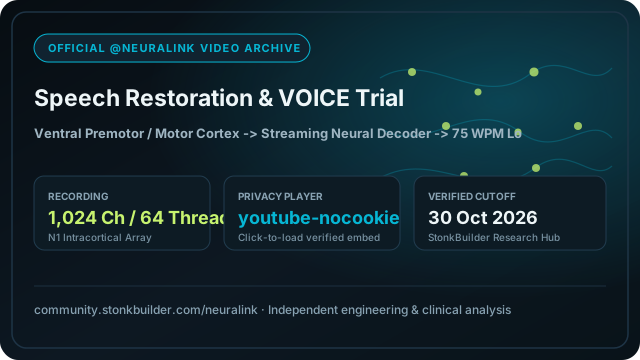
Official September 2026 update ('Restoring Speech with Neuralink') showing VOICE trial participants Kenneth and Terry training speech decoders and speaking aloud in their own personalized voices.
- 'Translating Thought To Speech' (
u8mmn9lOIyw, 18 Mar 2026): Introduced the first VOICE trial demonstration, showing intended speech decoded into live text and synthesized audio. - 'Restoring Speech with Neuralink' (
_j806JHhCRo, 28 Sep 2026): Showed participants Kenneth and Terry progressing from mimed vocalization to silent speech intent, with audio rendered in a voice clone trained on recordings of their voice before ALS progression. - '72 Hours to Build for a Neuralink Participant' (
emi5O7LeiyU, 29 Oct 2026): Documented a three-day engineering sprint inside a participant's home to build practical conversation tools, quick-response controls, and intent gating for daily family dialogue.
Official 29 October 2026 documentary ('72 Hours to Build for a Neuralink Participant') following Neuralink engineers inside a participant's home as they refine real-time speech tools.
How Neuralink's VOICE results compare with peer-reviewed 2025 academic studies
To evaluate Neuralink's company-reported VOICE updates rigorously, it helps to compare them with the peer-reviewed neuroprosthesis literature published in 2025:
| Dimension | Neuralink VOICE Trial (2026 disclosures) | Peer-reviewed academic benchmarks (Nature / Nature Neuroscience 2025) |
|---|---|---|
| Hardware interface | Wireless, fully implanted 1,024-channel N1 array (nl_speech, ct_voice) | Intracortical Utah arrays (UC Davis, *Nature* 2025) & high-density ECoG (*Nature Neuroscience* 2025) with percutaneous connectors. |
| Reported speed & accuracy | 75 WPM at 5.8% word error rate in week 1 for one participant (nl_speech) | Instantaneous (<10 ms latency) paralinguistic + pitch voice synthesis (*Nature* s41586-025-09127-3) and streaming brain-to-voice (*Nat. Neurosci.* s41593-025-01905-6). |
| Home usability | Fully wireless implant used inside participants' homes (emi5O7LeiyU) | Primarily cart-based laboratory setups tethered to external neural signal processors. |
| Publication status | Company clinical updates & registered trial NCT07224256; peer-reviewed paper pending | Full peer-reviewed datasets, open methods, and error-rate distributions. |
Sources checked 30 Oct 2026
Sources and official records
- [1] Neuralink: Speech Restoration (VOICE study overview) ↗ · Verified 30 Oct 2026
- [2] ClinicalTrials.gov: The VOICE Study for Communication Restoration (NCT07224256) ↗ · Verified 30 Oct 2026
- [3] Neuralink YouTube (2026-03-24): Translating Thought To Speech | Neuralink ↗ · Verified 30 Oct 2026
- [4] Neuralink YouTube (2026-09-18): Speaking With The Mind | Neuralink ↗ · Verified 30 Oct 2026
- [5] Neuralink YouTube (2026-10-29): An Engineering Sprint For Speech Restoration | Neuralink ↗ · Verified 30 Oct 2026
- [6] Nature (2025): An instantaneous voice-synthesis neuroprosthesis ↗ · Verified 30 Oct 2026
- [7] Nature Neuroscience (2025): A streaming brain-to-voice neuroprosthesis ↗ · Verified 30 Oct 2026