
Video · 4:3929 Oct 2026
An Engineering Sprint For Speech Restoration | Neuralink
Published on 29 October 2026, this 4-minute-39-second documentary follows a team of Neuralink engineers who spent 72 hours inside a VOICE clinical trial participant'…
An independent guide by StonkBuilder · Sources checked 30 Oct 2026
Neuralink is building a brain implant to help people with paralysis use computers and communicate. Here, you can see how it works, watch participants use it, and read what the trials have shown so far. There are still open questions about surgery, long-term reliability, and who might benefit.
Start here
Start with how the implant works, then read about the trials and the risks. If you came here for PreStocks, the last guide explains the token and what holding it means.
Follow a brain signal from the implant to the software that moves a cursor.
Read the guide →02 · The hardwareMeet the N1 implant, its thin electrode threads, and the R1 surgical robot.
Read the guide →03 · The trialsSee what each study is designed to find out, and how to read the reported results.
Read the guide →04 · The risksRead about surgical risks, signal loss, privacy, and the support an implanted device needs.
Read the guide →05 · What comes nextLook at the next research questions, including vision, alongside what has been tested so far.
Read the guide →06 · PreStocksUnderstand who can use it, the fees and risks, and why it does not give you Neuralink shares.
Read the guide →How it works
The R1 robot places thin electrode threads in the brain. The N1 implant records electrical signals and sends them wirelessly to software that turns them into commands. The diagram below follows that path.
Ultra-flexible polymer threads move with the brain rather than anchoring to the rigid skull.
Places each thread around surface vasculature; achieved first clinical transdural insertion in Jun 2026.
All outputs are evaluated under regulated clinical protocols (PRIME, CONVOY, VOICE) and are not FDA-approved for sale.
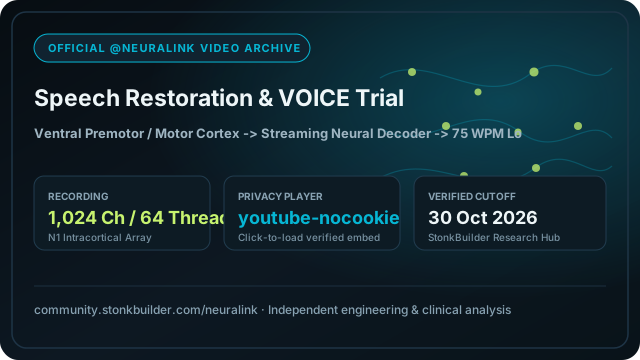
Published 29 October 2026: Neuralink engineers spend 72 hours in a VOICE trial participant's home building real-time speech tools.
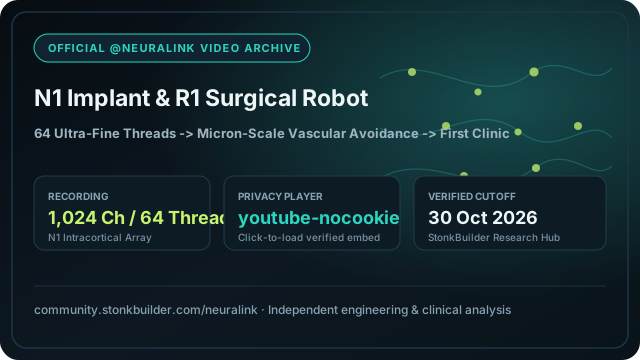
Published 30 June 2026: Inserting N1 electrode threads straight through the intact dura mater at UHN Toronto Western Hospital.
The evidence
A video can show what one participant can do. It cannot tell us how well an implant will work for everyone, or how long it will last. Here is what each type of evidence tells us.
| Type of evidence | What the sources show | What this does not establish |
|---|---|---|
| Demonstrated in human trial participantsCompany-reported demonstrations & video records (2024–2026) | Wireless 2D cursor control, web browsing, CAD design, gaming, digital painting (Audrey), handwriting signature decoding, assistive robotic arm control (CONVOY / Nick), early cursor-driven wheelchair steering (Jul 2026), and real-time brain-to-voice synthesis in a participant's own voice profile (VOICE / Kenneth & Terry, Mar–Oct 2026). | Individual participant demonstrations in early feasibility studies; outcomes vary across participants and do not establish general clinical efficacy or FDA marketing approval. |
| Active clinical study objectivesRegistered early feasibility protocols (NCT06429735, NCT07224256, CONVOY) | Evaluate primary safety (serious device- and procedure-related adverse events) and preliminary functional feasibility of the N1 Implant and R1 Robot for computer control (PRIME), external robotic devices (CONVOY), and communication restoration (VOICE), alongside surgical workflow improvements such as transdural thread insertion (Toronto Western Hospital, Jun 2026). | Permission to run an Investigational Device Exemption (IDE) clinical trial allows structured human testing; it is not commercial clearance. |
| Peer-reviewed & scientific contextPublished neuroprosthesis literature (Nature & Nature Neuroscience, 2025) | Independent academic BCI studies in Nature and Nature Neuroscience (2025) demonstrated instantaneous and streaming brain-to-voice synthesis using intracortical and high-density arrays, establishing peer-reviewed benchmarks for low-latency neural speech decoding that inform the broader field. | Peer-reviewed academic results from other research groups validate the neuroscientific principle but are separate from Neuralink's proprietary N1/VOICE clinical dataset. |
| Separate investigational & future aspirationsPreclinical R&D & long-term company roadmap (Summer/Fall 2025 updates) | Blindsight cortical visual prosthesis (received FDA Breakthrough Device designation in Sep 2024; preclinical NHP testing shown in Jun 2025), multi-implant spinal cord/motor reanimation concepts, and higher-channel next-generation implants. | Breakthrough Device designation expedites FDA regulatory dialogue; human vision restoration, spinal cord bridging, and consumer enhancement remain unproven aspirations requiring separate clinical trials. |
Keep reading
Learn about the hardware, speech research, or safety questions. Each guide includes diagrams, official videos, and links to its sources.
Learn how Neuralink's 1,024-electrode N1 implant, R1 surgical robot and real-time neural decoders translate brain signals into cursor and speech commands.
Read the guide →Technology · Research ExplainerTechnical breakdown of Neuralink's 1,024-channel N1 implant, R1 neurosurgical robot, femtosecond laser needles and the June 2026 transdural procedure.
Read the guide →Clinical Programs · Research ExplainerExplore how Neuralink PRIME study participants use Telepathy for wireless cursor control, CAD design, digital painting, gaming and handwriting decoding.
Read the guide →Clinical Programs · Research ExplainerCompare Neuralink's human clinical trials—PRIME, CONVOY and VOICE—including ClinicalTrials.gov IDs, eligibility, 21 enrolled participants and endpoints.
Read the guide →Clinical Programs · Research ExplainerHow Neuralink's VOICE clinical trial (NCT07224256) decodes speech-motor cortex activity into real-time text and personalized voice synthesis at up to 75 WPM.
Read the guide →Clinical Programs · Research ExplainerHow Neuralink's CONVOY study and Telepathy interfaces let participants control assistive robotic arms and steer powered wheelchairs with neural signals.
Read the guide →Clinical Programs · Research ExplainerWhat is Neuralink's Blindsight? Learn how V1 visual cortex microstimulation works, what FDA Breakthrough Device status means, and current preclinical limits.
Read the guide →Analysis & Context · Research ExplainerObjective analysis of Neuralink's clinical and ethical questions: surgical risks, thread retraction, biocompatibility, neural privacy and explant support.
Read the guide →Analysis & Context · Research ExplainerCompare Neuralink's flexible intracortical threads against rigid Utah arrays, cortical surface ECoG grids, endovascular stents (Synchron) and non-invasive EEG.
Read the guide →Analysis & Context · Research ExplainerComplete primary-source chronology of Neuralink from its 2019 launch and 2021 MindPong to FDA IDE clearance, 21 human participants and 2026 VOICE speech trials.
Read the guide →Analysis & Context · Research ExplainerAn evidence-graded guide to Neuralink's future possibilities: what works in human trials today, plausible extensions, Blindsight vision R&D, and speculation.
Read the guide →Step-by-step guide to tracking official Neuralink updates across neuralink.com, ClinicalTrials.gov and @neuralink YouTube while filtering out fake claims.
Open step-by-step guide →Step-by-Step Tutorial · 5 stepsStep-by-step tutorial on how to review Neuralink's PRIME, CONVOY and VOICE clinical trials, read ClinicalTrials.gov records and verify the Patient Registry.
Open step-by-step guide →Step-by-Step Tutorial · 6 stepsStep-by-step guide for eligible non-U.S. users to verify PreStocks' NEURALINK Solana token (PrekqL…bw9S), check transfer fees and understand non-equity risks.
Open step-by-step guide →From Neuralink’s YouTube channel
Browse 44 videos, Shorts, and livestreams from the official @neuralink channel, catalogued on 30 Oct 2026. Each has a written guide. Three open on YouTube because on-page playback is disabled.
Published on 29 October 2026, this 4-minute-39-second documentary follows a team of Neuralink engineers who spent 72 hours inside a VOICE clinical trial participant'…
Published on 18 September 2026 ('Speaking With The Mind | Neuralink', 6:56), this in-depth clinical feature profiles Terry, who was diagnosed with bulbar-onset ALS i…
Published on 23 July 2026 ('Telepathic Wheelchair Control | Neuralink', 1:57), this full horizontal demonstration shows a clinical trial participant navigating rooms…
Published on 30 June 2026 ('Our First Transdural Procedure | Neuralink', 5:11), this landmark engineering and surgical report documents the first clinical procedure …
Published on 15 May 2026 ('Creating Art With The Mind | Neuralink', 4:41), this documentary introduces Audrey, who became paralyzed from the neck down after a car ac…
Published on 3 December 2025 ('Neuralink Overview, Fall 2025', 21:39), this chaptered technical lecture provides one of the clearest end-to-end engineering briefings…
A Closer Look · 16 slides
A short presentation on the implant, the people testing it, and the questions still ahead. It also explains the separate PreStocks token. Read it here or save a copy.
About the PreStocks token
NEURALINK)Eligible users can access Neuralink-related economic exposure through PreStocks' NEURALINK token on Solana. The token is issued by PreStocks and is not a Neuralink share. Review the provider's current eligibility rules, fees and terms before proceeding.
| Attribute | Verified record | What to know |
|---|---|---|
| Product & symbol | Neuralink PreStocks · NEURALINK | Issued by PreStocks; not affiliated with or endorsed by Neuralink Corp. |
| Solana Token-2022 mint | PrekqLJvJ3qVdXmBGDiexvwUTF4rLFDa6HWS4HJbw9S | Verify on Solscan ↗ · Inspect on Jupiter ↗ |
| Shareholder rights | None (0% equity, voting or dividend rights) | Holding NEURALINK is not owning Neuralink Corp. shares. |
| Jurisdiction eligibility | Non-U.S. users only (36 jurisdictions barred) | Review PreStocks Terms of Service ↗ before proceeding. |
| Token-2022 transfer fee & controls | 1% (100 bps, epoch 1050) on 30 Oct 2026; 3% (300 bps) on 30 Sep 2026 | Authority WV9PJN7X…Fti5Wc holds mint, freeze, pause & permanent delegate extensions. |
| Valuation comparison | $650M Series E at a reported $9B pre-money valuation (2 Jun 2025) | Compare against PreStocks API mark ($62.93B provider mark ($330.37 mark price) in API snapshot (30 Oct 2026, not an executable quote)) and secondary snapshot ($83.78B implied by $439.81 secondary token price on 2,594.98 supply (30 Oct 2026 snapshot)). Never treat snapshots as executable quotes. |
https://learn.stonkbuilder.com/paths/first-steps/
https://learn.stonkbuilder.com/learn/protect-your-crypto-wallet/
https://learn.stonkbuilder.com/learn/spot-crypto-scams/
https://community.stonkbuilder.com/solana
Plain-English Definitions
Frequently Asked Questions
No. Every Neuralink device—including the N1 implant, the R1 surgical robot, and Blindsight—is investigational and has not received FDA marketing authorization. Access is limited to eligible volunteers enrolled in regulated clinical trials (such as PRIME, CONVOY, and VOICE) through Neuralink's Patient Registry.
In its official update 'Two Years of Telepathy' published on 28 January 2026, Neuralink reported that 21 participants ('Neuralnauts') had been enrolled across its clinical trials. Because enrollment continues over time, treat 21 as a dated January 2026 company disclosure rather than a static permanent total.
Telepathy is the product name for Neuralink's motor-decoding system that lets paralyzed users control computers and phones. PRIME (NCT06429735) is the foundational clinical trial testing N1/R1 safety and computer control. CONVOY tests controlling an assistive robotic arm. VOICE (NCT07224256) tests decoding intended speech into real-time text and natural voice. Blindsight is a separate preclinical/investigational program aiming to stimulate the visual cortex for blindness.
No. Neuralink's motor and speech interfaces read cortical signals and route them wirelessly to external computers, voice synthesizers, or robotic aids. That bypasses damaged nerves to restore digital or assistive autonomy, but it does not biologically repair a severed spinal cord or stop ALS motor-neuron degeneration.
Neuralink Corp. is a private company with no public stock ticker or announced IPO date; its last announced funding round was a $650 million Series E in June 2025 at a reported $9 billion pre-money valuation. NEURALINK (mint PrekqLJvJ3qVdXmBGDiexvwUTF4rLFDa6HWS4HJbw9S) is a Solana Token-2022 instrument issued by PreStocks that tracks private-market exposure via SPVs. It is not a Neuralink share, confers no voting or ownership rights, and is unavailable to U.S. persons.
Of the 44 verified public uploads on the official @neuralink channel (UCLt4d8cACHzrVvAz9gtaARA), 41 allow standard third-party embedding via youtube-nocookie.com. Three uploads—the 2019 Launch Event (r-vbh3t7WVI) and two April 2026 Shorts (9uqKeAJoD90 and kO6iakLQN0Y)—have external embedding disabled by the video owner (returning HTTP 401 on YouTube oEmbed). We document those three exceptions transparently and link directly to their official YouTube watch pages.
Always check the full 44-character Token-2022 mint address (PrekqLJvJ3qVdXmBGDiexvwUTF4rLFDa6HWS4HJbw9S) on Solscan and cross-reference it against prestocks.com/neuralink before connecting a wallet. Anyone can create a lookalike token named NEURALINK on Solana.
No. StonkBuilder Community is an independent educational library. We have no affiliation with Neuralink Corp. or PreStocks, and nothing on this site is medical or financial advice.
Sources checked 30 Oct 2026