
Future possibilities of Neuralink: separating demonstrated human trials from long-term speculation
What could Neuralink realistically enable over the next three, five, or fifteen years? Instead of treating every keynote aspiration as inevitable—or dismissing real human clinical breakthroughs as hype—this guide organizes Neuralink's future possibilities into four strict evidence tiers based on neurobiology, hardware readiness, and regulatory status.
- Category 1 (Demonstrated in human trials): Wireless computer control (
PRIME), early natural-voice speech synthesis (VOICE), and supervised assistive robotic-arm/wheelchair control (CONVOY). - Category 2 (Plausible extensions requiring further clinical evidence): Zero-calibration foundation decoders, sustained >100 WPM conversation, tactile feedback for prosthetics, and outpatient transdural surgery.
- Category 3 (Separate investigational programs): Blindsight cortical vision (
V1stimulation) and spinal motor bridging—each requiring distinct anatomy, safety data, and clinical trials. - Category 4 (Longer-term speculation): Elective human enhancement, memory prostheses, or 'whole-brain AI symbiosis' remain unproven in neuroscience and lack any regulatory path for healthy individuals.
Why evidence grading is essential when researching brain–computer interfaces
In Neuralink presentations, speakers often transition within minutes from showing a real clinical trial participant using a computer at home to discussing next-decade visions of restoring full-body mobility or mitigating artificial-intelligence risk. Both topics matter, but they sit at completely different levels of scientific maturity.
The 4-tier future possibilities matrix
| Evidence tier | Capabilities in this tier | Verified evidence today | Key scientific & regulatory boundary |
|---|---|---|---|
| Category 1 · Demonstrated or currently investigated in human trials | Computer cursor & keyboard control (Telepathy / PRIME), personalized brain-to-voice communication (VOICE), assistive robotic arm manipulation (CONVOY), and early camera-guided wheelchair steering. | Backed by registered human clinical trials (NCT06429735, NCT07224256) and dated official video demonstrations (2024–2026). | Outcomes reflect specific participants in supervised feasibility trials. Restoring an external digital or robotic control channel does not cure ALS or repair a damaged spinal cord. |
| Category 2 · Plausible engineering extensions requiring further clinical evidence | Higher sustained conversational speech rates approaching natural ~140 WPM, zero-calibration cross-day decoders via foundation neural models, multi-axis dexterous prosthetic hands with tactile feedback, and outpatient automated transdural surgery. | Supported by early engineering prototypes (e.g., 75 WPM / 5.8% WER first-week result in one participant; first transdural procedure in Jun 2026; self-supervised pretraining across >50,000 hours of neural data). | Requires multi-center pivotal trial validation, multi-year chronic electrode stability data, and FDA premarket approval (PMA) before becoming commercially available medical features. |
| Category 3 · Separate investigational programs (distinct anatomy & regulatory path) | Blindsight cortical visual prosthesis (stimulating primary visual cortex V1 to create phosphene perception for bilateral blindness) and investigational spinal/motor reanimation concepts. | Blindsight holds FDA Breakthrough Device designation (Sep 2024) and preclinical macaque stimulation data (Summer 2025 update), but relies on cortical stimulation (write) rather than motor recording (read). | Motor-cortex cursor control does not prove visual-cortex image restoration. Each indication requires its own safety profile, electrode geometry, stimulation limits, and regulatory authorization. |
| Category 4 · Longer-term speculation | Elective human enhancement, memory prostheses, whole-cortex high-bandwidth human–AI symbiosis, or unmediated thought sharing. | Discussed philosophically in long-horizon founder presentations (2019–2025) as a motivation for scaling channel count. | Purely speculative. Current neuroscience does not support arbitrary 'mind reading' or memory uploading, and no regulatory pathway exists for elective invasive implants in healthy individuals. |
Deep dive into Category 2 & 3: where near-term breakthroughs are most likely
Over the next several years, the most consequential progress is likely to come not from science-fiction scenarios, but from compounding engineering improvements in Categories 1, 2, and 3:
- From 75 WPM to natural ~140 WPM conversational speech: Combining higher-channel implants in speech-motor cortex with streaming acoustic decoders (
_j806JHhCRo,emi5O7LeiyU) and intent-gating interfaces that let users speak with natural prosody and emotion. - Zero-calibration foundation neural models: Scaling self-supervised pretraining well beyond the 50,000-hour mark (
QJdgHXyJh7M) so a new participant can use their implant immediately with minimal calibration. - Surgical simplification via transdural robotics: Expanding the June 2026 UHN Toronto transdural technique (
F8p2MamNBgE) and 1.5-second R1 thread insertion so procedures become shorter and more standardized across neurosurgical centers. - First-in-human cortical stimulation trials: Moving Blindsight from preclinical macaque testing (
FASMejN_5gs) into regulated human feasibility trials for bilateral blindness.
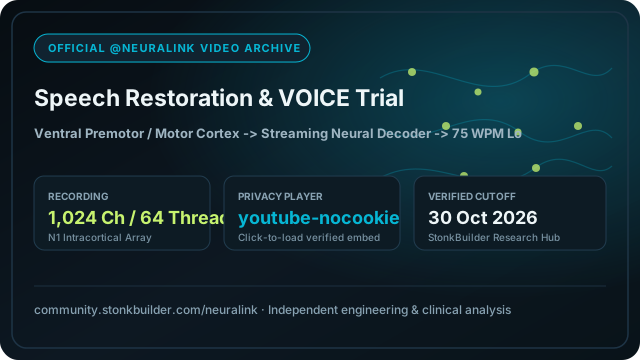
Official March 2026 video ('Translating Thought To Speech') illustrating how Neuralink is expanding from 2D motor cursor control into direct neural speech decoding.
Why Category 4 (elective enhancement & memory uploading) remains speculative
Why can't an intracortical implant simply 'download memories' or give a healthy person telepathic super-intelligence today? First, neuroscience knows the neural code for primary motor and primary sensory maps because those regions map systematically to muscles, vocal articulators, or visual space. High-level episodic memory and abstract reasoning are distributed dynamically across billions of synapses throughout association cortex and hippocampus; no known stimulation pattern encodes a complex concept.
Second, from a medical-ethics and FDA regulatory standpoint (fda_neuro), cranial neurosurgery carries non-zero risk of bleeding and infection. That risk-benefit ratio is justified only when treating severe paralysis, speech loss, or blindness—not for elective consumer upgrades in healthy people.
Sources checked 30 Oct 2026
Sources and official records
- [1] Neuralink: Two Years of Telepathy (28 Jan 2026) ↗ · Verified 30 Oct 2026
- [2] Neuralink: Speech Restoration (VOICE study overview) ↗ · Verified 30 Oct 2026
- [3] Neuralink: Breakthrough Device Designation for Blindsight ↗ · Verified 30 Oct 2026
- [4] U.S. FDA: Regulatory overview for neurological medical devices ↗ · Verified 30 Oct 2026
- [5] U.S. FDA: Implanted Brain-Computer Interface (BCI) Devices for Patients with Paralysis or Amputation ↗ · Verified 30 Oct 2026
- [6] Neuralink YouTube (2026-03-24): Translating Thought To Speech | Neuralink ↗ · Verified 30 Oct 2026
- [7] Neuralink YouTube (2025-12-03): Neuralink Overview, Fall 2025 ↗ · Verified 30 Oct 2026
- [8] Neuralink YouTube (2025-06-27): Neuralink Update, Summer 2025 ↗ · Verified 30 Oct 2026
- [9] Neuralink YouTube (2026-06-30): Our First Transdural Procedure | Neuralink ↗ · Verified 30 Oct 2026