
Translating Thought To Speech | Neuralink: technical breakdown, key moments and clinical context
Published on 24 March 2026 ('Translating Thought To Speech | Neuralink', 10:47), this flagship documentary introduces Neuralink's VOICE clinical trial (NCT07224256) through the story of Kenneth, who was diagnosed with ALS in 2024. Engineers and clinicians explain how recording directly from speech-motor cortex allows the decoder to bypass slow letter-by-letter cursor typing and synthesize continuous speech in Kenneth's own voice.
- Primary record: Official
@neuralinkvideo (u8mmn9lOIyw) published on 24 Mar 2026 (duration10:47). - What it shows: First comprehensive public demonstration of Neuralink's VOICE clinical trial (NCT07224256).
- Technical pathway: Speech motor cortex (64 threads) → N1 ASICs → streaming neural speech model → text + personalized voice.
- Evidence boundary: 10:47 flagship documentary on the VOICE clinical trial (NCT07224256).
Watch the official video record
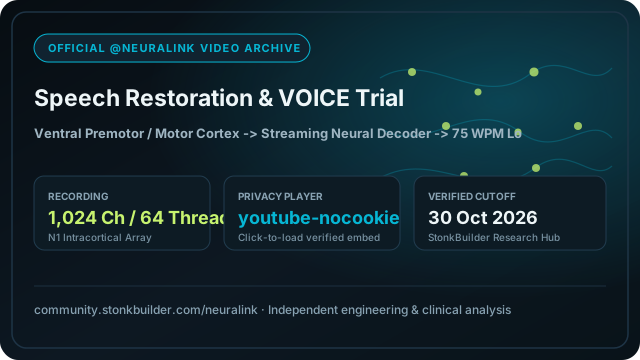
Official upload from @neuralink (24 Mar 2026, 10:47).
Read verbatim official @neuralink YouTube description & caption provenance
Caption & verification basis: English manual + auto-generated captions (Official video playback, English caption track, official description, and primary Neuralink disclosures).
Kenneth was diagnosed with amyotrophic lateral sclerosis (ALS) in 2024. As speaking became progressively harder, even short conversations with his wife were tiring, and everyday tasks like phone calls were nearly impossible.

When he learned about Neuralink, he discovered that brain-computer interfaces have the potential to restore communication by translating thought into speech. Now, as a participant in Neuralink’s VOICE clinical trial, he is pioneering technology that could give voices back to those who have lost them.

If you’re interested in helping shape the future of assistive technology, join us.

Careers: https://neuralink.com/careers
Patient Registry: https://neuralink.com/trials

Note: Neuralink devices are investigational and are not commercially available or FDA approved.
Technical pathway and evidence classification
Speech motor cortex (64 threads) → N1 ASICs → streaming neural speech model → text + personalized voice
10:47 flagship documentary on the VOICE clinical trial (NCT07224256).
Timestamped breakdown and key moments
| Timestamp | Segment / event | What happens in the segment |
|---|---|---|
00:00 | Kenneth's ALS diagnosis & communication loss | Documents how progressive dysarthria made phone calls and family conversations exhausting. |
02:40 | How speech-motor decoding works | Engineers explain why decoding intended vocal-tract movements is much faster than 2D cursor typing. |
05:30 | Calibration & personalized voice synthesis | Shows the real-time neural spike stream translating into on-screen words and Kenneth's natural voice. |
08:15 | Family impact & future VOICE roadmap | Reflects on daily home communication and the path toward conversational ~140 WPM speeds. |
What this video demonstrates—and what it does not establish
What this video demonstrates
- First comprehensive public demonstration of Neuralink's VOICE clinical trial (NCT07224256).
- End-to-end wireless brain-to-text and brain-to-voice synthesis in a human participant with ALS.
Scope limits & what it does not establish
- Single-participant documentary within an early feasibility study; peer-reviewed multi-subject error-rate papers remain pending.
How this fits into Neuralink's broader clinical and hardware roadmap
This video sits inside the Speech restoration (VOICE) research track on StonkBuilder's independent Neuralink hub. All Neuralink hardware (the N1 implant and R1 surgical robot) and clinical programs (PRIME NCT06429735, CONVOY, and VOICE NCT07224256) remain investigational and have not received FDA commercial marketing authorization. Read our full companion guide at Speech restoration (VOICE) for cohort context.
Sources checked 30 Oct 2026
Sources and official records
- [1] Neuralink YouTube (2026-03-24): Translating Thought To Speech | Neuralink ↗ · Verified 30 Oct 2026
- [2] Neuralink: Official YouTube Channel (@neuralink, UCLt4d8cACHzrVvAz9gtaARA) ↗ · Verified 30 Oct 2026
- [3] Neuralink: Official website and investigational device notice ↗ · Verified 30 Oct 2026
- [4] Neuralink: Speech Restoration (VOICE study overview) ↗ · Verified 30 Oct 2026
- [5] ClinicalTrials.gov: The VOICE Study for Communication Restoration (NCT07224256) ↗ · Verified 30 Oct 2026