
Article Memecoins
What is pump.fun? How the Solana memecoin launchpad works
pump.fun is a popular Solana app for launching memecoins. Anyone can launch a coin in a minute, for free, and anyone can trade it from the first second. Here is how a coin goes from idea to pool, what you pay on each trade and what to watch out for.
In short
- Creating a coin on pump.fun costs no platform fee. Every coin has 1 billion units.
- A new coin trades on a bonding curve: each buy raises the price and each sell lowers it.
- When all 793.1 million curve coins are sold, the coin graduates to a PumpSwap pool.
- Trades on the curve cost 1.25%, and some coins add a creator or holder fee of their own.
- Most new coins are pure speculation. pump.fun's own terms warn of a material risk of loss.
Words you'll meet
- Launchpad
- An app that lets people create a new token and start trading it straight away.
- Bonding curve
- A formula that sets a coin's price from how many coins have been bought so far.
- Graduation
- The moment a pump.fun coin sells out its curve and moves to a trading pool.
- PumpSwap
- pump.fun's own exchange, where graduated coins trade in pools.
- Market cap
- A coin's price times its total supply. Not money anyone can take out.
More words, explained plainly: the StonkBuilder Learn glossary ↗
pump.fun in one paragraph
pump.fun is a Solana app for launching and trading memecoins. Its own welcome screen says it lets anyone create coins and gives everyone equal access to buy and sell from the start. There is no platform fee to create a coin, and every coin follows the same rules.[1]
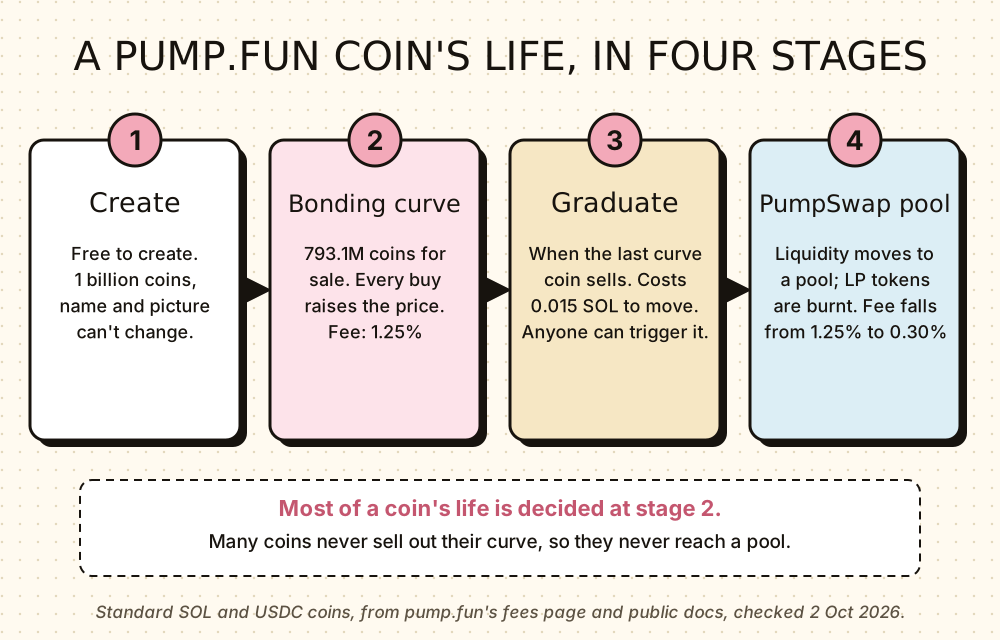
Stage 1: creating a coin
A creator picks a name, a ticker and a picture. The name, symbol and image can't be changed later.[2] Every coin starts with the same supply of 1,000,000,000 units,[3] and new coins use Solana's newer Token-2022 standard.[4]
Coins are paired with a quote token, the token you pay with. That is SOL by default and USDC since May 2026.[1] Some coins use another token, which pump.fun's docs call a custom pair.[4] $ARMORED, for example, is paired with ORE.
Stage 2: the bonding curve
A new coin is not in a normal pool. It trades against a program called the bonding curve, which holds 793.1 million of the coins for sale. Each buy takes coins from the curve and raises the price a little. Each sell returns coins and lowers it.[3] pump.fun says the curve works like a simple automated market maker, with no order book.[5]
Our bonding curve explainer shows the numbers: the last coins on the curve cost many times what the first ones did.
Stage 3: graduation
When the last of the 793.1 million curve coins is bought, the curve is complete. Anyone can then trigger the move to PumpSwap, and pump.fun charges 0.015 SOL for that migration.[3][1] Many coins never get this far.
Stage 4: the PumpSwap pool
After graduation the remaining coins and the money the curve collected move into a PumpSwap pool, and the pool's LP tokens are burnt, so nobody can pull that liquidity out.[5] From then on the coin trades like any pool token, and apps such as Jupiter can route to it.
What every trade costs
| Where | Total fee | Who gets it |
|---|---|---|
| Bonding curve | 1.25% | 0.95% pump.fun, 0.30% the coin's creator[1] |
| PumpSwap, small coins | 1.25% | Mostly pump.fun, some to the creator and the pool |
| PumpSwap, large coins | Falls to 0.30% | The creator's share shrinks as market cap grows |
| Network fee | A fraction of a cent | Solana validators, in SOL |
Coins on a custom pair can set their own creator fee.[4] With Holder Rewards switched on, that creator fee goes to the coin's holders instead of the creator.[6] Always look at the full fee before you trade. Our guide on Holder Rewards uses $ARMORED as the example.
How people use pump.fun today
- The website and apps. Since 25 September 2026 the website signs you in with email, Google, Apple or GitHub instead of a browser wallet.[7]
- Through Jupiter and wallets. Jupiter can route a swap to a coin's bonding curve or pool, so you can buy many pump.fun coins from your own Solana wallet.
- Holder Rewards coins. pump.fun lists coins whose creator fee is paid to holders, in the coin's pair token.[8]
The risks, honestly
- Most coins are pure speculation. pump.fun's terms warn that coin values can swing hard and carry a material risk of loss.[10]
- Prices move fast on the curve. Early buyers pay far less than late buyers, and can sell into late buyers' money.
- Copies are everywhere. Anyone can launch a coin with the same name and picture. Check the contract address with our memecoin checklist.
- Nobody needs your private key. pump.fun says it never asks for it in a DM, an email or on X.[7]
StonkBuilder Learn explains how to spot a crypto scam ↗ and why the contract address is a token's real name ↗. We are independent and not affiliated with pump.fun.
Questions people ask
Is pump.fun free to use?
Creating a coin has no platform fee. Trading has fees: 1.25% on the bonding curve and between 1.25% and 0.30% in PumpSwap pools, plus the Solana network fee.
What does it mean when a pump.fun coin graduates?
All 793.1 million coins on its bonding curve have been bought. Its liquidity then moves to a PumpSwap pool, where it trades like other pool tokens.
Do all pump.fun addresses end in pump?
Most coins launched from pump.fun's site do, but anyone can generate an address ending in pump. The ending proves nothing. Compare the full address with the project's own channels.
Can I use pump.fun with Phantom?
The website now signs in with email, Google, Apple or GitHub. You can still buy many pump.fun coins from Phantom or another wallet through Jupiter.
Is pump.fun safe?
The app is widely used, but the coins on it are highly speculative and many lose most of their value. Only use money you can afford to lose.
Go deeper in our project communities
Sources
- pump.fun: Fees ↗pump.fun/docs/fees
- pump.fun: Create a coin ↗pump.fun/docs/create-coin
- pump.fun public docs: The Pump program (bonding curve and graduation) ↗github.com/pump-fun/pump-public-docs/blob/main/docs/PUMP_PROGRAM_README.md
- pump.fun public docs: Coin creation and quote tokens ↗github.com/pump-fun/pump-public-docs/blob/main/docs/instructions/COIN_CREATION.md
- pump.fun: The bonding curve ↗pump.fun/docs/bonding-curve
- pump.fun public docs: Holder rewards coins ↗github.com/pump-fun/pump-public-docs/blob/main/docs/HOLDER_REWARDS_README.md
- pump.fun: Wallet sign-in changes ↗pump.fun/docs/wallet-login-changes
- pump.fun: Holder rewards ↗pump.fun/holder-rewards
- pump.fun: The PUMP token ↗pump.fun/pump-token
- pump.fun: Terms and conditions ↗pump.fun/docs/terms-and-conditions
Checked on 2 Oct 2026. Projects change their fees and features; the linked pages are the source of truth.
StonkBuilder Community writes independent, educational guides. We are not affiliated with, endorsed or sponsored by the projects we cover; names and trademarks belong to their owners. Nothing here is financial, investment or legal advice. Crypto prices are volatile and you can lose money.