
Article Memecoins
The pump.fun bonding curve, explained with real numbers
Every new pump.fun coin starts on a bonding curve, a formula that sets its price as people buy and sell. It explains why early buyers pay so little, why prices jump near the end and why most coins never leave the curve. Here it is with real numbers.
In short
- The curve holds 793.1 million coins for sale and prices them with a fixed formula.
- A SOL-paired coin starts at about 28 SOL of market cap and graduates at about 411 SOL.
- The last coins on the curve cost about 15 times the first. Early buyers can sell to late buyers.
- When the curve sells out, the coin moves to a PumpSwap pool and the LP tokens are burnt.
Words you'll meet
- Bonding curve
- A formula that sets a coin's price from how many coins have been bought so far.
- Virtual reserves
- Pretend balances the formula starts with, so the first price isn't zero.
- Constant product
- A pricing rule where coins times money in the pool stays the same on each trade.
- Graduation
- The moment a pump.fun coin sells out its curve and moves to a trading pool.
More words, explained plainly: the StonkBuilder Learn glossary ↗
The idea
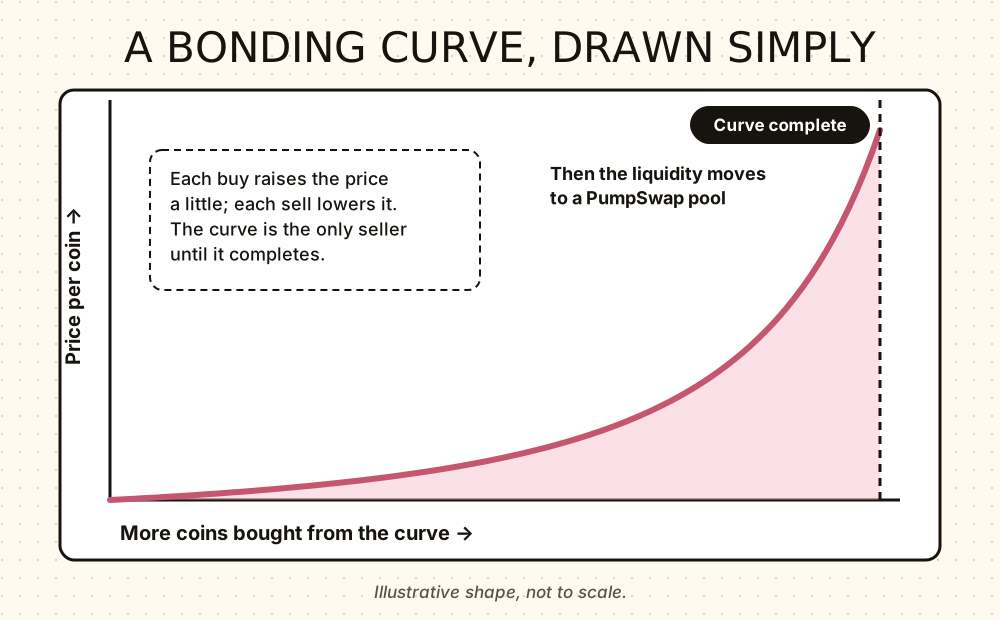
When a pump.fun coin is created, nobody has bought any yet, so there is no market to set a price. The bonding curve solves that. It is a program that sells coins and buys them back at a price set by a formula.[1]
The formula, in plain words
pump.fun's curve is a constant-product formula, the same idea many exchange pools use.[2] It starts with virtual reserves: 1,073,000,000 coins and 30 SOL for a SOL-paired coin. Only 793,100,000 of those coins are real coins for sale.[1] Coins times SOL stays the same on every trade, so as coins leave, the SOL needed for each one goes up.
The numbers
Here is what that means for a standard SOL-paired coin. We worked these out from the starting values in pump.fun's docs, before fees. They are not published by pump.fun.
| Curve sold | SOL paid in so far | Market cap |
|---|---|---|
| 0% | 0 SOL | about 28 SOL |
| 25% | about 6.8 SOL | about 42 SOL |
| 50% | about 17.6 SOL | about 70 SOL |
| 75% | about 37.3 SOL | about 141 SOL |
| 100%, graduation | about 85 SOL | about 411 SOL |
Look at the gap between rows. The first quarter of the curve takes under 7 SOL. The last quarter takes nearly 48. Buying the first 10 million coins costs about 0.28 SOL, while the last 10 million cost about 4 SOL, roughly 15 times more.
Why this matters to you
- Early and late buyers pay very different prices. If early buyers sell, they are paid with late buyers' money, and the price falls.
- Small trades move the price. Near the end of the curve, even a modest buy moves the price a lot.
- Fees come on top. Every curve trade pays 1.25%, and coins on custom pairs can add a creator or holder fee.[3]
- Most coins never graduate. If buyers stop coming, the coin can sit on its curve for good.
What happens at graduation
When the last real coin is bought, the curve is marked complete. Anyone can then call the migrate instruction, which moves the liquidity to a PumpSwap pool.[1] pump.fun says this is automatic and irreversible, and the pool's LP tokens are burnt.[2] Moving costs 0.015 SOL.[3]
Curves on other pairs
Coins paired with USDC or another token work the same way, with that token in place of SOL. $ARMORED, paired with ORE, is one example: its price and its graduation point are measured in ORE. Our article on why $ARMORED trades against ORE explains what that changes.
Questions people ask
How many coins are on a pump.fun bonding curve?
793,100,000 of the 1,000,000,000 supply. The rest move to the PumpSwap pool at graduation.
At what market cap does a pump.fun coin graduate?
For a SOL-paired coin, at about 411 SOL of market cap, after about 85 SOL has been paid into the curve. That is our arithmetic from pump.fun's starting values, before fees.
Can a pump.fun coin go back to the bonding curve?
No. pump.fun describes the move to PumpSwap as automatic and irreversible.
Why did the price jump when I bought?
On a curve, your own buy raises the price. Near the end of the curve each coin costs much more, so the jump is bigger.
Go deeper in our project communities
Sources
- pump.fun public docs: The Pump program (bonding curve and graduation) ↗github.com/pump-fun/pump-public-docs/blob/main/docs/PUMP_PROGRAM_README.md
- pump.fun: The bonding curve ↗pump.fun/docs/bonding-curve
- pump.fun: Fees ↗pump.fun/docs/fees
Checked on 2 Oct 2026. Projects change their fees and features; the linked pages are the source of truth.
StonkBuilder Community writes independent, educational guides. We are not affiliated with, endorsed or sponsored by the projects we cover; names and trademarks belong to their owners. Nothing here is financial, investment or legal advice. Crypto prices are volatile and you can lose money.