
Speaking With The Mind | Neuralink: technical breakdown, key moments and clinical context
Published on 18 September 2026 ('Speaking With The Mind | Neuralink', 6:56), this in-depth clinical feature profiles Terry, who was diagnosed with bulbar-onset ALS in 2024. Although Terry retained limb movement, progressive dysarthria made his natural speech nearly unintelligible. The video documents how Terry trained the VOICE decoder first by miming words and then by simply thinking them—hearing his thoughts spoken aloud in his own pre-ALS voice.
- Primary record: Official
@neuralinkvideo (_j806JHhCRo) published on 18 Sep 2026 (duration6:56). - What it shows: Feasibility of neural speech restoration specifically in bulbar-onset ALS where speech loss precedes full limb paralysis.
- Technical pathway: Speech motor cortex → mimed-to-silent calibration → phoneme decoder → personalized natural voice.
- Evidence boundary: Single-participant clinical case profile in NCT07224256; outcomes vary across ALS stages.
Watch the official video record
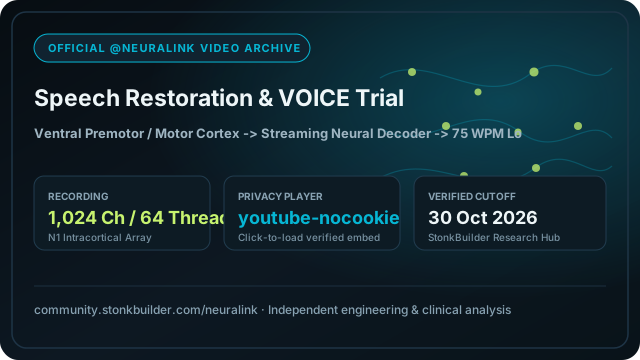
Official upload from @neuralink (18 Sep 2026, 6:56).
Read verbatim official @neuralink YouTube description & caption provenance
Caption & verification basis: English manual + auto-generated captions (Official video playback, English caption track, official description, and primary Neuralink disclosures).
Terry was diagnosed with bulbar-onset amyotrophic lateral sclerosis (ALS) in 2024. While he is still able to move his mouth and body, his speech has become impaired to the point where his loved ones have difficulty understanding him.

Through the VOICE trial, Terry is using his Neuralink implant to help fine-tune a brain-to-voice interface for himself and others who can’t speak. He trained the algorithm first by miming speech as best he could, then by simply thinking the words and hearing them come out in his own natural voice.

If you’re interested in helping shape the future of assistive technology, join us.

Careers: https://neuralink.com/careers
Patient Registry: https://neuralink.com/trials

Neuralink devices are investigational and have not been approved by the FDA or other regulatory authorities. This video features voluntary clinical trial participants sharing their personal experiences, which may not reflect all participants or future outcomes.
Technical pathway and evidence classification
Speech motor cortex → mimed-to-silent calibration → phoneme decoder → personalized natural voice
Single-participant clinical case profile in NCT07224256; outcomes vary across ALS stages.
Timestamped breakdown and key moments
| Timestamp | Segment / event | What happens in the segment |
|---|---|---|
00:00 | Bulbar-onset ALS clinical presentation | Explains how bulbar ALS selectively impairs speech and swallowing while other motor functions may remain intact. |
02:05 | Two-step decoder calibration | Shows Terry training the neural decoder first by miming vocal movements and then transitioning to silent thought. |
04:15 | Speaking in his own voice | Demonstrates real-time brain-to-voice synthesis restoring natural family conversation. |
05:50 | Clinical trial outlook | Discusses what speech restoration means for ALS autonomy and future VOICE study participants. |
What this video demonstrates—and what it does not establish
What this video demonstrates
- Feasibility of neural speech restoration specifically in bulbar-onset ALS where speech loss precedes full limb paralysis.
- Two-stage transfer learning from overt/mimed articulation to silent speech intention.
Scope limits & what it does not establish
- Investigational early feasibility demonstration; does not halt underlying ALS neurodegeneration.
How this fits into Neuralink's broader clinical and hardware roadmap
This video sits inside the Speech restoration (VOICE) research track on StonkBuilder's independent Neuralink hub. All Neuralink hardware (the N1 implant and R1 surgical robot) and clinical programs (PRIME NCT06429735, CONVOY, and VOICE NCT07224256) remain investigational and have not received FDA commercial marketing authorization. Read our full companion guide at Speech restoration (VOICE) for cohort context.
Sources checked 30 Oct 2026
Sources and official records
- [1] Neuralink YouTube (2026-09-18): Speaking With The Mind | Neuralink ↗ · Verified 30 Oct 2026
- [2] Neuralink: Official YouTube Channel (@neuralink, UCLt4d8cACHzrVvAz9gtaARA) ↗ · Verified 30 Oct 2026
- [3] Neuralink: Official website and investigational device notice ↗ · Verified 30 Oct 2026
- [4] Neuralink: Speech Restoration (VOICE study overview) ↗ · Verified 30 Oct 2026
- [5] ClinicalTrials.gov: The VOICE Study for Communication Restoration (NCT07224256) ↗ · Verified 30 Oct 2026