
An Engineering Sprint For Speech Restoration | Neuralink: technical breakdown, key moments and clinical context
Published on 29 October 2026, this 4-minute-39-second documentary follows a team of Neuralink engineers who spent 72 hours inside a VOICE clinical trial participant's home for a focused hackathon. Rather than testing in a clinical lab, the team prototyped and user-tested real-time conversation features—reducing turn-taking latency, refining intent gating so background thoughts do not trigger speech, and tailoring the interface for everyday family dialogue.
- Primary record: Official
@neuralinkvideo (emi5O7LeiyU) published on 29 Oct 2026 (duration4:39). - What it shows: Independent in-home operation of the wireless N1 speech-decoding pipeline outside a hospital setting.
- Technical pathway: Speech-motor cortex → N1 wireless stream → real-time speech decoder → home conversation UI & cloned voice.
- Evidence boundary: Single-participant 72-hour in-home engineering sprint in the VOICE study; features are experimental prototypes.
Watch the official video record
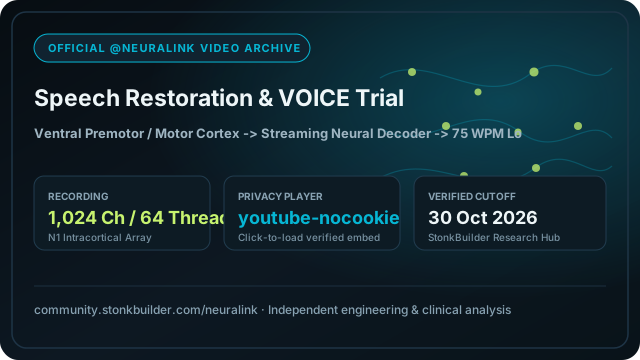
Official upload from @neuralink (29 Oct 2026, 4:39).
Read verbatim official @neuralink YouTube description & caption provenance
Caption & verification basis: English manual + auto-generated captions (Official video playback, English caption track, official description, and primary Neuralink disclosures).
Our engineers recently spent 72 hours with a participant in our speech restoration study at his home for a hackathon. The goal was simple: rapidly prototype as many features as possible to improve the experience of using Neuralink to communicate with thought, and test every one of them with the end user.

Neuralink devices are investigational and have not been approved by the FDA or other regulatory authorities. This video features voluntary clinical trial participants sharing their personal experiences, which may not reflect all participants or future outcomes.
Technical pathway and evidence classification
Speech-motor cortex → N1 wireless stream → real-time speech decoder → home conversation UI & cloned voice
Single-participant 72-hour in-home engineering sprint in the VOICE study; features are experimental prototypes.
Timestamped breakdown and key moments
| Timestamp | Segment / event | What happens in the segment |
|---|---|---|
00:00 | Arrival & 72-hour hackathon goal | Engineers set up inside the participant's living room to co-design speech features directly with the end user and family. |
01:15 | Real-time conversation bottlenecks | Identifies why lab word-per-minute scores alone do not solve group dinner-table turn-taking or quick interjections. |
02:30 | Rapid prototyping & intent gating | Iterative testing of low-latency synthesis, mute/engagement controls, and personalized voice phrasing. |
03:45 | End-of-sprint family conversation | Demonstrates the participant using the newly built speech tools in unscripted home dialogue. |
What this video demonstrates—and what it does not establish
What this video demonstrates
- Independent in-home operation of the wireless N1 speech-decoding pipeline outside a hospital setting.
- Human-centered co-design between neural decoding engineers and an enrolled VOICE study participant.
- Practical software safeguards (intent gating and quick conversational controls) needed for daily home speech use.
Scope limits & what it does not establish
- Represents a single-participant engineering sprint under an investigational IDE protocol (NCT07224256), not a commercial product release.
- Does not report multi-participant statistical word error rate (WER) distributions across the full VOICE cohort.
How this fits into Neuralink's broader clinical and hardware roadmap
This video sits inside the Speech restoration (VOICE) research track on StonkBuilder's independent Neuralink hub. All Neuralink hardware (the N1 implant and R1 surgical robot) and clinical programs (PRIME NCT06429735, CONVOY, and VOICE NCT07224256) remain investigational and have not received FDA commercial marketing authorization. Read our full companion guide at Speech restoration (VOICE) for cohort context.
Sources checked 30 Oct 2026
Sources and official records
- [1] Neuralink YouTube (2026-10-29): An Engineering Sprint For Speech Restoration | Neuralink ↗ · Verified 30 Oct 2026
- [2] Neuralink: Official YouTube Channel (@neuralink, UCLt4d8cACHzrVvAz9gtaARA) ↗ · Verified 30 Oct 2026
- [3] Neuralink: Official website and investigational device notice ↗ · Verified 30 Oct 2026
- [4] Neuralink: Speech Restoration (VOICE study overview) ↗ · Verified 30 Oct 2026
- [5] ClinicalTrials.gov: The VOICE Study for Communication Restoration (NCT07224256) ↗ · Verified 30 Oct 2026