
a beautiful surprise: technical breakdown, key moments and clinical context
This 24-second official Short ('a beautiful surprise', 18 September 2026) captures the emotional moment VOICE trial participant Terry—diagnosed with bulbar-onset ALS in 2024—speaks to his family using silent neural intent rendered in his own natural pre-ALS voice profile.
- Primary record: Official
@neuralinkshort (yd9T8gHIPis) published on 18 Sep 2026 (duration0:24). - What it shows: Transition from mimed speech training to silent speech-intent decoding in a participant with bulbar ALS.
- Technical pathway: Silent speech intent → N1 1,024-ch readout → brain-to-voice model → Grok Voice personalized synthesis.
- Evidence boundary: 24-second highlight Short from Terry's VOICE trial session; pair with the full 6:56 video (_j806JHhCRo).
Watch the official video record
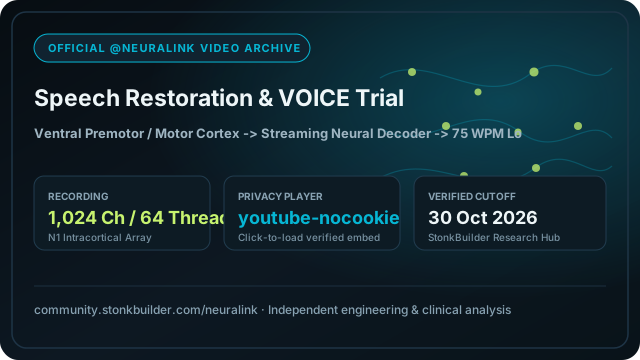
Official upload from @neuralink (18 Sep 2026, 0:24).
Read verbatim official @neuralink YouTube description & caption provenance
Caption & verification basis: English auto-generated captions (Official video playback, English caption track, official description, and primary Neuralink disclosures).
Through the VOICE trial, Terry is using his Neuralink implant to help fine-tune a brain-to-voice interface for himself and others who can’t speak. He trained the algorithm first by miming speech as best he could, then by simply thinking the words and hearing them come out in his own natural voice.

Powered by Grok Voice from SpaceXAI

Neuralink devices are investigational and have not been approved by the FDA or other regulatory authorities. This video features voluntary clinical trial participants sharing their personal experiences, which may not reflect all participants or future outcomes.
Technical pathway and evidence classification
Silent speech intent → N1 1,024-ch readout → brain-to-voice model → Grok Voice personalized synthesis
24-second highlight Short from Terry's VOICE trial session; pair with the full 6:56 video (_j806JHhCRo).
Timestamped breakdown and key moments
| Timestamp | Segment / event | What happens in the segment |
|---|---|---|
00:00 | Silent speech intent | Terry thinks a phrase without relying on intelligible vocal-cord phonation. |
00:10 | Personalized voice output | The decoder synthesizes the words in Terry's natural voice timbre, surprising his loved ones. |
What this video demonstrates—and what it does not establish
What this video demonstrates
- Transition from mimed speech training to silent speech-intent decoding in a participant with bulbar ALS.
- Integration of personalized voice-cloning synthesis (noted in the official description as powered by Grok Voice) with neural decoding.
Scope limits & what it does not establish
- Short highlight clip; see the companion full video `_j806JHhCRo` for the training progression and clinical context.
How this fits into Neuralink's broader clinical and hardware roadmap
This video sits inside the Speech restoration (VOICE) research track on StonkBuilder's independent Neuralink hub. All Neuralink hardware (the N1 implant and R1 surgical robot) and clinical programs (PRIME NCT06429735, CONVOY, and VOICE NCT07224256) remain investigational and have not received FDA commercial marketing authorization. Read our full companion guide at Speech restoration (VOICE) for cohort context.
Sources checked 30 Oct 2026
Sources and official records
- [1] Neuralink YouTube (2026-09-18): a beautiful surprise ↗ · Verified 30 Oct 2026
- [2] Neuralink: Official YouTube Channel (@neuralink, UCLt4d8cACHzrVvAz9gtaARA) ↗ · Verified 30 Oct 2026
- [3] Neuralink: Official website and investigational device notice ↗ · Verified 30 Oct 2026
- [4] Neuralink: Speech Restoration (VOICE study overview) ↗ · Verified 30 Oct 2026
- [5] ClinicalTrials.gov: The VOICE Study for Communication Restoration (NCT07224256) ↗ · Verified 30 Oct 2026