
Building Brain Interfaces For ALS: technical breakdown, key moments and clinical context
Published on 14 April 2026 ('Building Brain Interfaces For ALS', 0:59 Short), Neuralink machine-learning engineer Skyler explains what motor-neuron degeneration is in ALS and why recording directly from the cerebral cortex allows a BCI to bypass degenerating lower motor pathways to restore speech. Note: External iframe embedding is disabled by the video owner (YouTube oEmbed HTTP 401); use the direct Watch on YouTube button.
- Primary record: Official
@neuralinkshort (kO6iakLQN0Y) published on 14 Apr 2026 (duration0:59). - What it shows: Neurobiological rationale for why cortical BCIs can still decode intent in ALS patients whose peripheral nerves are failing.
- Technical pathway: Intact speech-motor cortex in ALS → N1 spike recording → ML speech decoder → synthesized voice bypass.
- Evidence boundary: External embedding disabled by video owner (oEmbed 401); verified via watch page and English captions.
Watch the official video record
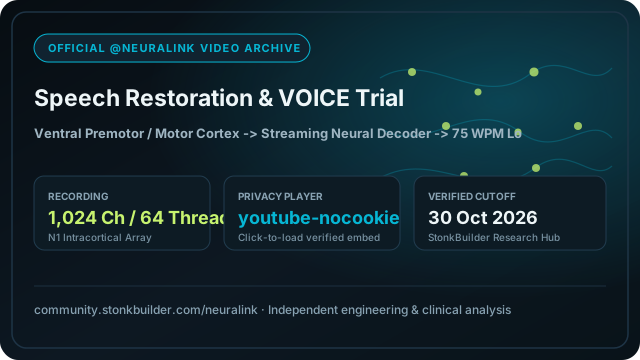
Official upload from @neuralink (14 Apr 2026, 0:59).
Read verbatim official @neuralink YouTube description & caption provenance
Caption & verification basis: English auto-generated captions (Official video playback, English caption track, official description, and primary Neuralink disclosures).
What is neuron degeneration?

Skyler, a machine learning engineer at Neuralink, shares how brain-computer interfaces could bypass neural pathways that are broken due to ALS, helping restore the ability to speak to those who have lost it.

Watch the full story here: https://youtu.be/u8mmn9lOIyw

Note: Neuralink devices are investigational and are not commercially available or FDA approved. There are no guaranteed benefits from participating in a Neuralink clinical trial.
Technical pathway and evidence classification
Intact speech-motor cortex in ALS → N1 spike recording → ML speech decoder → synthesized voice bypass
External embedding disabled by video owner (oEmbed 401); verified via watch page and English captions.
Timestamped breakdown and key moments
| Timestamp | Segment / event | What happens in the segment |
|---|---|---|
00:00 | What happens in motor-neuron degeneration | Explains how ALS damages the nerve pathways carrying commands from brain to muscle. |
00:28 | Cortical bypass for speech restoration | Shows how ML decoders read intact cortical speech intent upstream of the damaged nerves. |
What this video demonstrates—and what it does not establish
What this video demonstrates
- Neurobiological rationale for why cortical BCIs can still decode intent in ALS patients whose peripheral nerves are failing.
Scope limits & what it does not establish
- A cortical bypass restores an external communication channel; it does not slow or cure ALS motor-neuron disease.
How this fits into Neuralink's broader clinical and hardware roadmap
This video sits inside the Speech restoration (VOICE) research track on StonkBuilder's independent Neuralink hub. All Neuralink hardware (the N1 implant and R1 surgical robot) and clinical programs (PRIME NCT06429735, CONVOY, and VOICE NCT07224256) remain investigational and have not received FDA commercial marketing authorization. Read our full companion guide at Speech restoration (VOICE) for cohort context.
Sources checked 30 Oct 2026
Sources and official records
- [1] Neuralink YouTube (2026-04-14): Building Brain Interfaces For ALS ↗ · Verified 30 Oct 2026
- [2] Neuralink: Official YouTube Channel (@neuralink, UCLt4d8cACHzrVvAz9gtaARA) ↗ · Verified 30 Oct 2026
- [3] Neuralink: Official website and investigational device notice ↗ · Verified 30 Oct 2026
- [4] Neuralink: Speech Restoration (VOICE study overview) ↗ · Verified 30 Oct 2026
- [5] ClinicalTrials.gov: The VOICE Study for Communication Restoration (NCT07224256) ↗ · Verified 30 Oct 2026